
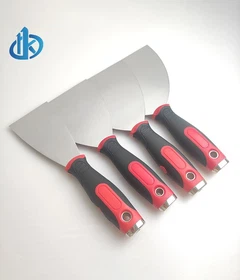
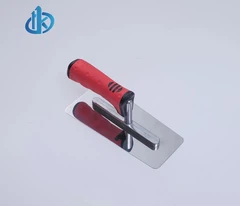
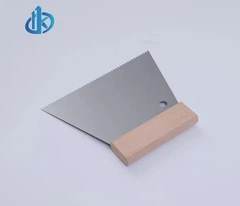
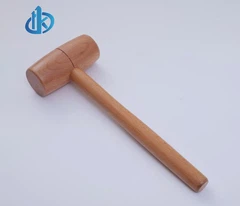
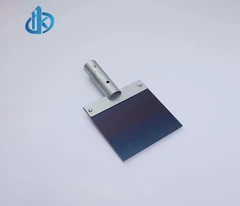

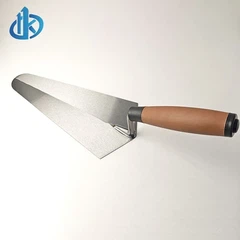


What is Plaster Trowel
Plaster trowels are usually stainless steel, carbon steel, or gold. The leading edge must be farther from the wall than the usual 10-15 mm. A plasterer's finish trowel can be upgraded with minimal effort and regular maintenance. Drag your box cutter across a similar instrument to assess its sharpness.
-
![Professional Decorative Carbon Steel Plaster Trowel]() Professional Decorative Carbon Steel Plaster TrowelDurable using professional decorative carbon steel plaster trowel with normal polished blade and plastic handle, concrete finishing trowel, hand tool drywall trowel.view more
Professional Decorative Carbon Steel Plaster TrowelDurable using professional decorative carbon steel plaster trowel with normal polished blade and plastic handle, concrete finishing trowel, hand tool drywall trowel.view more -
![Rubber Handle Plastering Trowel]() Rubber Handle Plastering TrowelHigh quality cement and concrete finishing trowel, stainless steel blade, rubber handle plastering trowel, polished brick and stone trowel, concrete processing tools gypsum trowel, wall board...view more
Rubber Handle Plastering TrowelHigh quality cement and concrete finishing trowel, stainless steel blade, rubber handle plastering trowel, polished brick and stone trowel, concrete processing tools gypsum trowel, wall board...view more -
![Hand Tool Stainless Steel Concrete Trowel]() Hand Tool Stainless Steel Concrete TrowelOur stainless steel concrete plaster trowel is designed for professional plasterers, contractors, builders, and distributors who demand reliable quality and long-lasting performance....view more
Hand Tool Stainless Steel Concrete TrowelOur stainless steel concrete plaster trowel is designed for professional plasterers, contractors, builders, and distributors who demand reliable quality and long-lasting performance....view more -
![1/4" Tile Trowel]() 1/4" Tile TrowelThe 1/4" Tile Trowel is especially handy for tiles that need strong, even support. The ridges are deep enough to hold plenty of mortar but not so big that it turns into a mess.view more
1/4" Tile TrowelThe 1/4" Tile Trowel is especially handy for tiles that need strong, even support. The ridges are deep enough to hold plenty of mortar but not so big that it turns into a mess.view more
When... -
![1/4" Square Notch Trowel]() 1/4" Square Notch TrowelWe are a 20+ years source factory in Junan Linyi, OEM for famous US & EU brands. This 1/4" Square Notch Trowel adopts mirror steel blade & anti-slip PP handle, full in-house production with strict...view more
1/4" Square Notch TrowelWe are a 20+ years source factory in Junan Linyi, OEM for famous US & EU brands. This 1/4" Square Notch Trowel adopts mirror steel blade & anti-slip PP handle, full in-house production with strict...view more -
![1/4" Inch Tile Trowel]() 1/4" Inch Tile TrowelThe beauty of the 1/4" Inch Tile Trowel is that it works for a wide range of projects. Whether you’re putting subway tiles in the kitchen or smaller floor tiles in a bathroom, it lays down mortar...view more
1/4" Inch Tile TrowelThe beauty of the 1/4" Inch Tile Trowel is that it works for a wide range of projects. Whether you’re putting subway tiles in the kitchen or smaller floor tiles in a bathroom, it lays down mortar...view more -
![1/4" Inch Square Notch Trowel]() 1/4" Inch Square Notch TrowelFinding a reliable supplier is just as important as choosing the right trowel.view more
1/4" Inch Square Notch TrowelFinding a reliable supplier is just as important as choosing the right trowel.view more
At Hanke Tools, we have specialised in manufacturing professional hand tools for nearly 30 years, supplying... -
![1/4" Inch Notched Trowel]() 1/4" Inch Notched TrowelWhat I like about the 1/4" Inch Notched Trowel is the balance. The ridges it leaves are just right—not too thin, not too heavy. When you press your tile down, it sticks firm without glue spilling...view more
1/4" Inch Notched TrowelWhat I like about the 1/4" Inch Notched Trowel is the balance. The ridges it leaves are just right—not too thin, not too heavy. When you press your tile down, it sticks firm without glue spilling...view more -
![1/8 Inch V Notch Trowel]() 1/8 Inch V Notch TrowelWhat I like most about the 1/8 Inch V Notch Trowel is how tidy the work looks. You’re not wasting adhesive, and you’re not cleaning up glue squeezing out from every edge. It’s faster, cleaner, and...view more
1/8 Inch V Notch TrowelWhat I like most about the 1/8 Inch V Notch Trowel is how tidy the work looks. You’re not wasting adhesive, and you’re not cleaning up glue squeezing out from every edge. It’s faster, cleaner, and...view more -
![1/8 Inch Notched Trowel]() 1/8 Inch Notched TrowelWith a 1/8 Inch Notched Trowel, the grooves are neat and consistent. That means the adhesive spreads evenly, and when you press the tile in, it beds properly without lumps or empty spots...view more
1/8 Inch Notched TrowelWith a 1/8 Inch Notched Trowel, the grooves are neat and consistent. That means the adhesive spreads evenly, and when you press the tile in, it beds properly without lumps or empty spots...view more -
![24 Inch Plastering Trowel]() 24 Inch Plastering TrowelWith a 24 Inch Plastering Trowel, you cover way more space in one go. Fewer passes mean fewer lines, smoother walls, and less time wasted. It’s like mowing a lawn—you don’t wanna cut an acre with...view more
24 Inch Plastering TrowelWith a 24 Inch Plastering Trowel, you cover way more space in one go. Fewer passes mean fewer lines, smoother walls, and less time wasted. It’s like mowing a lawn—you don’t wanna cut an acre with...view more -
![Plaster Hawk And Trowel]() Plaster Hawk And TrowelWhat I love about a Plaster Hawk And Trowel is how much easier it makes big jobs. You’re not stopping every five minutes to reload. You’re not chasing plaster sliding off some flimsy board. It’s...view more
Plaster Hawk And TrowelWhat I love about a Plaster Hawk And Trowel is how much easier it makes big jobs. You’re not stopping every five minutes to reload. You’re not chasing plaster sliding off some flimsy board. It’s...view more


Why Choose Us
Professional team
It has a professional development team, skilled workers and advanced production equipment, as well as a complete management system and strict quality control to meet customers' high standards.
Our certifications
The factory has BSCI and FSC certification, and the main markets for its products are North America, South America, Europe, Australia and other countries and regions.
Good service
High-quality after-sales service, tracking usage, and positive feedback. Rapid response within 24 hours.
Competitive price
We are very competitive in terms of quality, price, delivery time, etc.Good Quality + Factory Price + Quick Response + Reliable Service, is what we are trying best to offer you.
Benefits of Plaster Trowel
Finish faster
Getting the job done to the same high quality but in less time is every tradesman's dream, which is why automated tools and targeted area tools sell like hot cakes. Learning how to use a corner trowel is essential for faster finishing, but once you have mastered it and apply the right amount of pressure you will see flawless finishing in half the time.
Tackles the hard to reach
As touched on above, tackling the hard to reach corners and areas is every plasterers pet peeve, but with a corner trowel you can reduce your frustrations thanks to the angles on the tool provided that will make it much easier to tackle those hard to reach places with ease.
A multi functional tool
You may be wondering if a corner trowel is worthy of the investment when it seems the only function is easing corner plastering. It can also be useful when you are trying to tape a joint when drywalling.Apply the drywall tape fold to the corner and press it tightly to the wall, squeezing out any excess mud. Making sure you squeeze out the excess mud will reduce the bubbles and help the compound to dry faster.
Types of Plaster Trowel
Rectangular trowels, also called finishing trowels or square plastering trowels, are the backbone of the process, doing most of the work of getting the plaster on the wall and troweled to the right thickness. They have sharp, rectangular corners, are made of stiff steel, and come in a range of lengths and widths. A tang, or rib, that runs along the back gives the tool strength and rigidity, and connects to the handle. Though they're called finishing trowels, it's often easier to get a smooth finish with a pool trowel than a rectangular trowel. Without practice, the sharp corners of a finishing trowel can leave lines where they dig into the surface.
Pool trowels come in later in the process, and do most of the smoothing. These have rounded ends and are far more flexible than square-ended trowels. The combination of the trowels' round ends and flexibility keeps them from gouging the surface, leaving a smoother finish than their rectangular cousins. It's not that a smooth finish can't be achieved with rectangular trowels; it's just easier to do with a pool trowel. Like finishing trowels, these also come in various sizes.
Lime plastering has a long history in Japan, where they've developed a lot of different trowels to do the job. The ones used in this process are midsized and have triangular points up front and square ends in the back. These particular trowels are made of stainless steel and are very flexible. Their small size and flexibility makes them ideal for getting into tighter spaces, and for putting the finishing touches on small areas. They're great for rounding over outside corners, and for detailing areas where two outside corners meet. They're also good at setting the mesh tape on inside and outside corners, and smoothing out edges after removing tape screed lines from the ceiling, trim, and windows.
Typically used to get small amounts of material into narrow areas, margin trowels are useful for setting fiber mesh tape in inside and outside corners. The trowel's long, narrow blade sticks out from the handle, allowing it to access tight spaces that larger trowels can't reach.
What is the best Plaster Trowel size?
This is a key factor you need to consider when buying a trowel. The size of your plastering trowel affects your control, speed and pressure when plastering.
If you buy a 16″trowel you have the ability to get a lot more plaster on your walls compared to using a 13″trowel. On the other hand, a 12″trowel holds a lot less plaster but provides more control compared to an 18″plastering trowel.So the question is which is best? Is it better to have a longer trowel which holds more plaster or a smaller trowel which provides more control? My answer is simple.
Use a 14″plastering trowel. This sized trowel can spread a good amount of plaster with the optimum amount of control. It's isn't too stressful on your joints and it's a great weight to work with.
I've worked with all sized trowels and always returned to my trusty 14. I believe this is the ultimate sized trowel for all forms of plaster. It's easy to work with, great for render and finish plaster alike and makes it easy to use for your more intricate forms of plaster.
How to Use a Plaster Trowel
Prepare the Surface
Before applying plaster, ensure that the surface is clean, dry, and free of any debris. Proper surface preparation is essential for achieving a smooth and even finish.
Mix the Plaster
Prepare the plaster mixture according to the manufacturer's instructions. Achieving the right consistency is crucial for easy application and a professional finish.
Load the Trowel
Using our high-quality brick trowel, scoop an appropriate amount of plaster onto the blade. Avoid overloading the trowel to maintain control during application.
Apply the Plaster
Starting from the bottom of the surface, use the plastering trowel to apply the plaster in smooth, even strokes. Maintain a consistent pressure to ensure an even application.
Smooth and Level
Once the plaster is applied, use the flat edge of the trowel to smooth and level the surface. Pay attention to any uneven areas and work them until the surface is uniform.
Finish and Clean
After achieving the desired finish, clean any excess plaster from the trowel and allow the plaster to dry according to the manufacturer's recommendations.
How to Choose Plaster Trowel
Lightweight and comfortable
Firstly, a good plaster trowel should be lightweight and pleasant to hold. A heavy trowel can lead to fatigue in your joints and affect the quality of your plastering. Look for trowels with a soft grip such as rubber, and a good knuckle clearance between the handle and blade so you can work with ease. Some trowel handles have a finger guard which offers a soft finish where your index finger pushes against it as you work making it a lot more comfortable to use for prolonged periods.


Right size
Plaster trowel come in different sizes, and the right size for you depends on your project and comfort level. The bigger the trowel, the more surface area you'll be able to add plaster to in one go but the higher the skill level required. However the smaller the trowel, the more control you'll have, and the greater the likelihood of more of the trowel's surface staying in contact with the plaster providing a neater surface. A 14-inch size is generally a good all-around option and will leave a good finish.
Durable material
Make sure to choose a trowel made from durable material. Plaster trowel usually offer the best combination of durability and flexibility as they do not rust, making them a long-lasting tool. A plastic trowel needs less maintenance and is lighter to hold, but more susceptible to damage than a stronger metal trowel.

Process of Plaster Trowel
Material Selection
The blade of Plaster Trowel is often made from high-carbon steel or stainless steel. High-carbon steel provides strength and durability, while stainless steel offers resistance to corrosion.
The handle can be made from various materials such as wood, plastic, or rubber, depending on the manufacturer's preference and the intended use of the putty knife.
Cutting and Shaping
The blade material is cut and shaped into the desired form for the putty knife. This may involve stamping, laser cutting, or other precision cutting methods.The blade typically has a flat, wide shape with a beveled edge to facilitate the spreading and smoothing of putty or other materials.
Heat Treatment
The blade undergoes a heat treatment process to achieve the necessary hardness and toughness. This involves heating the steel to a specific temperature and then cooling it in a controlled manner.
Grinding and Sharpening
The blade is ground and sharpened to achieve the desired edge. This step is crucial for ensuring the putty knife effectively spreads and smoothens putty or other materials.
Handle Attachment
If the handle is made separately from the blade, it is attached to the blade. Handles can be attached using various methods, such as riveting or welding, depending on the design and materials.
Surface Coating (Optional)
Some Plaster Trowel may undergo a surface coating process to enhance corrosion resistance or provide other specific properties. For example, a non-stick coating may be applied to make it easier to clean the blade.
Quality Control
Plaster Trowel knife undergoes quality control checks to ensure it meets the manufacturer's specifications. This may involve checking dimensions, sharpness, and overall build quality.
How to Maintain Plaster Trowel
Cleaning
To clean the trowel you will need a bucket of water, an old rag, a wire brush, sand and oil. Start the procedure by dunking the trowel into the bucket of water. This loosens the dirt.Next, wipe off the trowel with the rag. The rag can also be used to wipe off some light dirt from the handle. If there is any dirt that does not come off with water and rag, then use the wire brush to scrape it off. The wire brush is also ideal for removing rust spots on the blade.Once the dirt is cleaned from the blade, you need to oil it to protect it from rust. It is suggested that you use oil that does not have petroleum in it like vegetable or linseed oil. Don't forget to coat the handle if it is made of wood to preserve and waterproof it.
Sharpening
You should sharpen the blade of the trowel every couple of years or so.
To sharpen the blade
Hold the trowel tightly onto a level surface with your non-dominant hand.Use your dominant hand to place the file on the edge of the blade at an angle between five and thirty degrees. Push the file downwards along the edge of the blade away from your body.Between each stroke lift the file from the tool and place it back at the starting point.Repeat the process all around the edge of the blade.Use a clean rag to rub on some vegetable or linseed oil.
Our Factory
Linyi Hanke Tools Co, Ltd.,located in Linyi, the largest hardware city in China. This is a professional manufacturer of building decoration tools, products cover putty tools, plaster tools, paint tools, wood tools and so on. The company covers an area of 18,000 square meters, more than 100 employees.The company has a professional development team, skilled workers and advanced production equipment, as well as perfect management system and strict quality control, to meet customers' high standards, high demand. The factory has BSCI and FSC certification, the main market of products are North America, South America, Europe, Australia and other countries and regions.
FAQ
As one of the leading plaster trowel manufacturers in China, we warmly welcome you to wholesale cheap plaster trowel from our factory. All custom made tools are with high quality and competitive price. Contact us for more details.


