
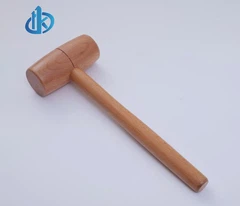



What is Wooden Hammer
One may confuse the term Wooden Hammer with a mallet that has a wooden handle. Since their names are based on the material of the mallet's head, a Wooden Hammer is essentially a mallet with a wooden head.It could have a handle made out of another material but since attaching a wooden head to another material is troublesome from a manufacturing perspective, wooden mallets are usually completely made out of wood.
-
![Wooden Mallet Furniture]() Wooden Mallet FurnitureLinyi Hanke Tools has been in the hand tool industry for 30 years, supplying putty knives and wooden mallets for furniture to European and American furniture factories all year round....view more
Wooden Mallet FurnitureLinyi Hanke Tools has been in the hand tool industry for 30 years, supplying putty knives and wooden mallets for furniture to European and American furniture factories all year round....view more -
![Wooden Mallet For Sale]() Wooden Mallet For SaleHandcraft studios in Europe often place bulk orders, and customers say, "Your wooden mallets not only have good quality but also are very easy to use."view more
Wooden Mallet For SaleHandcraft studios in Europe often place bulk orders, and customers say, "Your wooden mallets not only have good quality but also are very easy to use."view more
Today, we will introduce this... -
![Mallet Weight]() Mallet WeightLinyi Hanke Tools has been making hand tools for 30 years, including putty knives and wooden mallets, with regular orders from woodworking workshops across Europe and America.view more
Mallet WeightLinyi Hanke Tools has been making hand tools for 30 years, including putty knives and wooden mallets, with regular orders from woodworking workshops across Europe and America.view more
Many... -
![Making A Wood Mallet]() Making A Wood MalletOur Linyi Hanker Tools Factory has been dedicated to hand tool manufacturing for 30 years, with products sold to over 20 countries worldwide.view more
Making A Wood MalletOur Linyi Hanker Tools Factory has been dedicated to hand tool manufacturing for 30 years, with products sold to over 20 countries worldwide.view more
Today we recommend this making a wood... -
![Make A Wooden Mallet]() Make A Wooden MalletOur Linyi Hanker Tools Factory has been specializing in manufacturing for 30 years, with products exported to European and American markets.view more
Make A Wooden MalletOur Linyi Hanker Tools Factory has been specializing in manufacturing for 30 years, with products exported to European and American markets.view more
Today we present our make a wooden mallet, a... -
![Best Mallet For Woodworking]() Best Mallet For WoodworkingWoodworking masters know the importance of choosing the right mallet. Since 2000, our Linyi Hanker Tools factory has been dedicated to crafting premium best mallet for woodworking, trusted by...view more
Best Mallet For WoodworkingWoodworking masters know the importance of choosing the right mallet. Since 2000, our Linyi Hanker Tools factory has been dedicated to crafting premium best mallet for woodworking, trusted by...view more -
![Mallet For Sale]() Mallet For SaleMany buyers from Europe and America say, “Your mallets on sale are reliable in both quality and adaptability.”view more
Mallet For SaleMany buyers from Europe and America say, “Your mallets on sale are reliable in both quality and adaptability.”view more
Today, we’re introducing our cost-effective mallet for sale—whether you’re... -
![Hammers Mallet]() Hammers MalletLinyi Hanke Tools has been making hand tools for 30 years, including putty knives, wooden mallets, and metal hammers. Many customers say, “Your tools are easy to use, and we don’t feel confused...view more
Hammers MalletLinyi Hanke Tools has been making hand tools for 30 years, including putty knives, wooden mallets, and metal hammers. Many customers say, “Your tools are easy to use, and we don’t feel confused...view more -
![Hammers And Mallets]() Hammers And MalletsLinyi Hanke Tools has been making hand tools for 30 years, offering putty knives, beech wooden mallets, and metal hammers. Many long-term customers say, “Your company clearly explains which tool...view more
Hammers And MalletsLinyi Hanke Tools has been making hand tools for 30 years, offering putty knives, beech wooden mallets, and metal hammers. Many long-term customers say, “Your company clearly explains which tool...view more -
![Diy Wood Mallet]() Diy Wood MalletMany users say, “Your mallets are easy to use even for beginners.”view more
Diy Wood MalletMany users say, “Your mallets are easy to use even for beginners.”view more
Today, we’re focusing on our diy wood mallet designed specifically for craft lovers—it understands DIY needs better... -
![Big Wooden Hammer]() Big Wooden HammerMany customers say, “Your big wooden hammers make heavy work so much easier.”view more
Big Wooden HammerMany customers say, “Your big wooden hammers make heavy work so much easier.”view more
Today, we’re focusing on our big wooden hammer—designed specifically for heavy-duty woodworking.
... -
![Woodworking Mallets]() Woodworking MalletsHanke Tools has crafted hand tools for 30 years, from putty knives to woodworking mallets, with regular orders coming in from veteran woodworkers across Europe.view more
Woodworking MalletsHanke Tools has crafted hand tools for 30 years, from putty knives to woodworking mallets, with regular orders coming in from veteran woodworkers across Europe.view more
Many note, “Your mallets...


Why Choose Us
Professional team
It has a professional development team, skilled workers and advanced production equipment, as well as a complete management system and strict quality control to meet customers' high standards.
Our certifications
The factory has BSCI and FSC certification, and the main markets for its products are North America, South America, Europe, Australia and other countries and regions.
Good service
High-quality after-sales service, tracking usage, and positive feedback. Rapid response within 24 hours.
Competitive price
We are very competitive in terms of quality, price, delivery time, etc.Good Quality + Factory Price + Quick Response + Reliable Service, is what we are trying best to offer you.
Benefits of Wooden Hammer
The handle is more durable: Because the compressed wood hammer has been specially treated, it has better durability and wear resistance.
Strong anti-warping performance: The wooden hammer needs to be hammered frequently when used. If the handle is not strong enough, it will warp. The handle of a compression wood hammer has better resistance to warping and has a longer service life.
Comfortable in hand: The handle of the compression wooden hammer is smooth and comfortable in hand, and will not sting the palm.
Types of Wooden Hammer
Wooden Mallet Hammer
This hammer is a 4.5 "movable birch square hammer,wooden mallet hammer is suitable for a variety of wood workpiece tapping, wood planer installation and adjustment, wood chisel, wood carving knife tapping carving.Birch material is the best choice of high-end furniture materials, the production of mallets highlight the atmosphere, hard texture, balance, impact resistance, clear texture, uniform wood texture, soft tone, smooth.
Round Wood Heel Hammer
There are three models of birch round hammer: 50 mm birch round hammer, 60 mm birch round hammer, 60 mm birch parallel bar round hammer.Multi-purpose birch round wood heel hammer,strong and durable , esay to use,suitable for factory, home installation, woodworking, engraving and other purposes.
Little Wooden Hammer
This is a 4.5 inch beech square hammer.This kind of hammer for wood is solid wood hammer, knock resistant, strong enough,suitable for woodworking installation planer, furniture making, wood chisel tapping and so on.Made of natural beech, clear and beautiful texture, air impact, high hardness, strong toughness.The surface of the hammer is smooth and will not hurt objects when struck.
Small Wooden Mallet Hammer
This is a 4.5 inch beech removable square hammer,wooden hammer mallet is suitable for a variety of wood workpiece tapping, wood planer installation and adjustment, wood chisel, wood carving knife tapping carving.From the principle of ergonomic design, the operation process is more comfortable and does not hurt hands. Flip handle, prevent falling off, safer to use. The seams are tight and dense.
Application of Wooden Hammer
If you find yourself regularly working with wood or happen to be an amateur (or professional) carpenter, then a Wooden Hammer needs to be part of your repertoire. In woodworking, the entire premise is about joining two pieces of wood together.The reason to invest in a Wooden Hammer is to do so without leaving dents or doing damage to the surface of the wood. You can use the mallet in a forceful way in confidence while also using it to drive any nails into the wood without damaging either the wood or the nail. A regular hammer isn't totally useless in woodworking, but they tend to do more damage than good.
Whether you are working with mechanical or woodworking components that require tension, a Wooden Hammer is going to be your go-to tool. Tensioning those components is primarily done when reassembling machinery or furniture.Because of the softer head of the mallet, it doesn't generate too much force. It is essentially tapping those pieces into place rather than really hammering them. The components wind up in the right position and you have less of a chance of misaligning them. Have a mallet on hand to save yourself serious trouble.
It doesn't matter whether you are laying tile or carpet, it is critical to have tools that aren't going to mark up the finished surface. For something really delicate like ceramic tile, you really can't afford to apply too much force because it can shatter that material altogether. That means needing something that can apply force without doing damage along the way.A Wooden Hammer is critical for installing carpet or tile. You can gently tap pieces of tile or carpet accurately into place with no worries. Don't dent or chip the surface of the material, ruining it before it is ever fully installed. There is nothing worse than getting through the installation and finding a damaged piece of material.
Joints are a critical part of woodworking. In even the most novice of projects, there are probably going to be joints that need to come together safely and securely. Having a Wooden Hammer will be your tool of choice in joint tapping.
Handle
The Backbone of the Hammer.The handle serves as the foundation of the hammer, providing the necessary grip and leverage. Crafted from various materials like wood, fiberglass, or steel, each type offers distinct advantages. Wooden handles offer a traditional feel, while fiberglass and steel boast durability and resilience. Choosing the right handle material ensures a comfortable and efficient hammering experience.
Head
Striking the Right Balance.The head is the striking force behind every hammer blow. Balancing weight and size is crucial to achieve optimal impact. There are various types of hammer heads, including curved, straight, and cross-pein, each tailored for specific applications. Understanding the dynamics of hammer heads empowers users to select the right tool for the task at hand.
Claw
A Multi-Functional Tail.The claw, positioned opposite the striking face, adds versatility to the hammer. It serves a dual purpose-pulling out nails and prying materials apart. The design of the claw varies among hammers, with curved and straight claws being common. This component transforms a hammer into a multi-functional tool, extending its utility beyond mere striking.
Face
Where Striking Precision Counts.The face of the hammer is the surface that makes direct contact with the target. Different faces cater to distinct needs. A smooth face provides clean and even strikes, making it suitable for finishing tasks. Conversely, a textured or waffled face enhances grip and prevents slippage, ensuring precision in every hit.
Grip
Comfort in Every Swing.The grip, often underestimated, significantly influences the user’s comfort and control. Ergonomically designed grips reduce hand fatigue and improve handling precision. Whether it’s a T-handle, straight handle, or a contoured grip, choosing the right one enhances the overall hammering experience.

1.Framing hammers have long handles and heavy heads weighing up to 28 ounces. These ruggedly built tools are intended for framing contractors and homebuilders.
2.Checkered or waffle-faced models help prevent the hammer from slipping off nail heads.
3.A good general-purpose 16-ounce hammer comes in choice of handles made of wood, graphite or steel. Each is engineered to absorb vibration.
4.Specialty hammers include models for working with slate shingles and wood shingles.
5.A wood-shingle hammer has a measuring gauge and hatchet end for splitting shingles.
6.A ball-peen hammer is used for metalworking. Its head has a flat surface and rounded end.
7.Brick hammers are used to set and cut brick and stone.
8.Always wear safety glasses when using any type of hammer.
9.Grasp the hammer near end of the handle where there's typically a comfortable curve or depression.
10.When swinging the hammer, keep your eye on the nail head, raise the hammer high in the air and allow the weight of the hammer to drive the nail.
11.Pull nails using a straight (a.k.a. ripping) claw or side nail puller.
12.Curved-claw hammers provide more leverage for pulling nails.
13.Place a scrap board beneath the hammerhead when pulling nails to increase leverage and protect the workpiece.
Process of Wooden Hammer
Forming the head
The head is made by a process called hot forging. A length of steel bar is heated to about 2,200-2,350° F (1,200-1,300° C). This may be done with open flame torches or by passing the bar through a high-power electrical induction coil.The hot bar may then be cut into shorter lengths, called blanks, or it may be fed continuously into a hot forge. The bar or blanks are positioned between two formed cavities, called dies, within the forge. One die is held in a fixed position, and the other is attached to a movable ram. The ram forces the two dies together under great pressure, squeezing the hot steel into the shape of the two cavities. This process is repeated several times using different shaped dies to gradually form the hammer head. The forging process aligns the internal grain structure of the steel and provides much stronger and more durable piece.
Forming the handle
If the hammer has a wood handle, it is formed on a lathe. A piece of wood is cut to the desired length and secured at each end in the lathe. As the wood spins around the long axis of the handle, a cutting tool moves in and out rapidly to cut the handle profile. The position of the cutting tool is driven by a cam that has the same shape as the finished handle. As the cutting tool moves down the length of the handle, it follows the shape of the cam and cuts the handle to match it. The finished handle is clamped in a holding device and a slot is cut diagonally across the top of the handle. The handle is then sanded to give it a smooth surface.
Assembling the hammer
If the hammer has a wood handle, the handle is inserted up through the adze eye of the head. A wood wedge is tapped down into the diagonal slot on the top of the handle to force the two halves outward to press against the head. This provides sufficient friction to hold the head on the handle. The wood wedge is secured in place with two smaller steel wedges driven through it crossways. The handle may then be stenciled with ink or labeled with an adhesive sticker to show the manufacturer, brand name, or other information.
Quality Control
In addition to the normal visual inspections and dimensional measurements, various steps in the manufacturing process are monitored. Probably the most important step is the heat treatment used to harden portions of the head. The temperatures and rate of heating and cooling are critical in forming the proper hardness, and the entire operation is closely controlled.
How to Maintain Wooden Hammer
Keep it clean
After every use, clean your hammer with a dry cloth to remove any debris. Moisture and dirt can cause rust, which can weaken the hammer's head and handle.
Store it in a dry place
Keep your hammer in a dry place to prevent moisture from causing rust. You can use a toolbox or a pegboard to store your hammer safely.
Check the head regularly
Inspect the hammer's head regularly for any signs of damage, such as chips or cracks. A damaged head can cause nails to bend or break, which can affect the roof's stability.
Tighten the handle
The handle of your hammer can become loose over time. Check the handle's tightness regularly and tighten it if necessary. A loose handle can cause accidents and affect the hammer's accuracy.

Our Factory
Linyi Hanke Tools Co, Ltd.,located in Linyi, the largest hardware city in China. This is a professional manufacturer of building decoration tools, products cover putty tools, plaster tools, paint tools, wood tools and so on. The company covers an area of 18,000 square meters, more than 100 employees.The company has a professional development team, skilled workers and advanced production equipment, as well as perfect management system and strict quality control, to meet customers' high standards, high demand. The factory has BSCI and FSC certification, the main market of products are North America, South America, Europe, Australia and other countries and regions.
FAQ
As one of the leading wooden hammer manufacturers in China, we warmly welcome you to wholesale cheap wooden hammer from our factory. All custom made tools are with high quality and competitive price. Contact us for more details.


