



Customization of Acrylic Scrapers
An acrylic scraper is a scraping tool mainly made of acrylic (polymethyl methacrylate).

Customization of Blued Scrapers
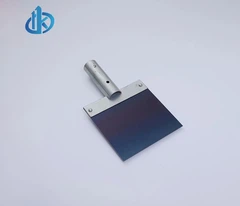
A blued scraper is a kind of scraper tool that has undergone the bluing treatment.

Customization of Carbon Steel Scrapers
Carbon steel scrapers are tools mainly made of carbon steel and used for scraping operations.

Customization of Integrally Connected Scrapers
The blade and handle (or other connecting parts) of an integrally connected scraper adopt an integrated manufacturing process or connection method, forming an indivisible whole structure.

Customization of Plastic-handled Scrapers
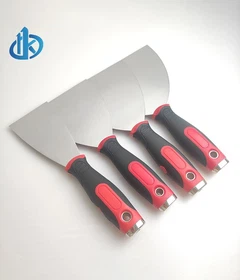
Plastic-handled scrapers mainly consist of two parts: the blade and the plastic handle.

Customization of Riveted-Handle Scrapers
As the name suggests, a riveted scraper fixes the scraper blade and handle by means of rivets.

Customization of Rubber Scrapers
A rubber scraper is a scraping tool mainly made of rubber.

Customization of Rubber-Plastic Handled Scrapers
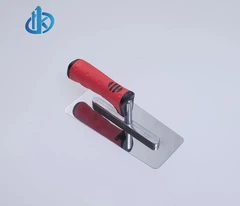
Rubber-plastic handled scrapers mainly consist of a blade and a rubber-plastic handle.

Customization of Stainless Steel Scrapers
A stainless steel scraper is a scraping tool mainly made of stainless steel.

Customization of Wood-handled Scrapers
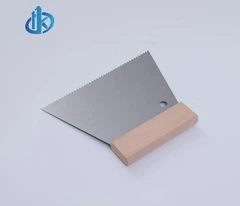
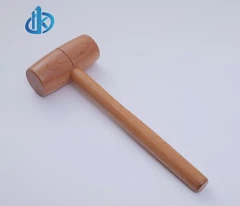
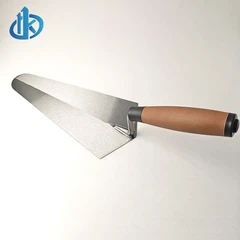
As the name implies, a wood-handled scraper mainly consists of two parts: the blade and the wooden handle.
Introduction to Scrapers
A scraper is usually a handheld tool, mainly composed of two parts: the blade and the handle. The blade is generally flat, and its materials are diverse, including metals (such as carbon steel, stainless steel), plastics, and rubber. Metal blades are hard and have strong durability, capable of withstanding relatively large pressure for handling harder materials. Plastic blades are relatively soft and are often used for operating on relatively fragile surfaces to avoid scratches. The design of the handle focuses on ergonomics, and its shape and material will vary according to the usage scenarios and user requirements, aiming to provide users with a comfortable gripping experience and facilitate use.
Applications
Scrapers have a wide range of uses in numerous fields, such as building decoration, floor installation and maintenance, automotive repair and beauty, handicraft making and processing, leather product manufacturing, and industrial production.
Characteristics of Different Types
Flat-blade Scrapers
The edge of the blade of a flat-blade scraper is straight. This design enables it to provide a large area of contact when scraping flat surfaces, ensuring stable operation. It is suitable for large-area material removal or application work and is widely used in scenarios like applying putty on building walls and cleaning the surfaces of industrial equipment.
Curved-blade Scrapers
The blade of a curved-blade scraper is in an arc shape, which can better fit round or curved surfaces. When used in repairing the curved parts of automobile bodies or trimming the surfaces of ceramic blanks in ceramic art production (especially for some ceramic works with curves), it can effectively fit the surface of the object for scraping operations.
Classification of Categories
By Shape
Mainly including rectangular, strip-shaped, curved, etc.
By Blade Material
Mainly including carbon steel, stainless steel, plastic, rubber, etc.
By Handle Material
Mainly including wood, plastic, rubber-plastic, etc.
By Blade Size
Mainly including conventional specifications such as 150mm, 200mm, 300mm, 400mm, 500mm, 600mm, as well as other sizes customized according to customer requirements.
Process for Customers to Customize Scrapers
|
Process |
Process Details |
|
Requirement Communication |
Customers contact our company through telephone, email or online customer service, and detail their requirements regarding the usage scenarios of the scraper, preferences for blade and handle materials, size, color and appearance design, etc. Our sales staff will communicate with customers in a timely manner and offer suggestions. |
|
Scheme Formulation |
After the requirements are clear, our design team will formulate a preliminary design scheme based on the requirements, combined with product functions and production processes, including scraper size, material selection, function selection, appearance design, etc., and communicate with customers in a timely manner for confirmation. |
|
Customer Feedback |
Customers review the scheme. If they agree with the design scheme, our company will produce samples; if not, both parties will continue to communicate and adjust the scheme until the customer is satisfied. |
|
Sample Confirmation and Business Negotiation |
After producing samples, our company will send the samples to the customers. After the customers confirm the samples, both parties will negotiate on issues such as quotations, contracts, order quantities, packaging, LOGO, and outer boxes. |
|
Production and Delivery |
After both parties confirm all details, our company will arrange production according to the sample standards. After production is completed, quality inspections will be carried out. Once qualified, the products will be packaged and delivered to the customers as agreed. |
Explanation
Our company can customize scrapers with conventional shapes, sizes and materials according to customer requirements, and can also customize other unconventional scrapers as required by customers. For specific schemes, customers can contact our company's sales staff to formulate them.