
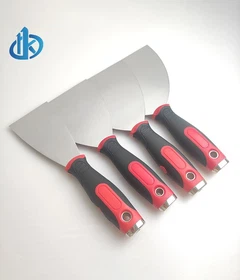
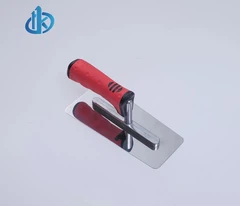
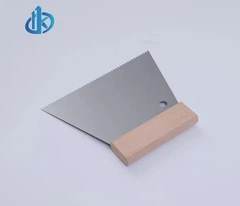
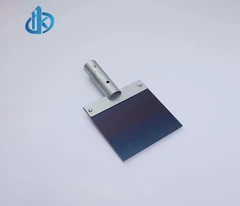

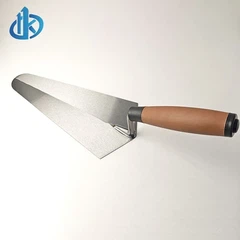

Both outside and inside corner trowels are essential tools in construction and finishing, yet they possess distinct characteristics that set them apart.

Starting with the design, an outside corner trowel typically features a blade with a right-angled or slightly rounded right angle shape. This conformation is purpose-built to wrap around the outer edges of corners, like those on exterior walls, columns, or building facades. It provides a broad, flat surface that allows for even application of materials such as mortar, stucco, or caulk. When constructing a brick wall, for example, the outside corner trowel ensures the mortar is spread uniformly along the corner, strengthening the structure and giving it a clean, finished look that withstands the elements.
In contrast, the inside corner trowel sports a concave or V-shaped blade. This unique design enables it to nestle perfectly into the interior corners where two surfaces meet, like the junctions of drywall panels or cabinet sides. In drywall finishing, it allows for precise application of joint compound, reaching deep into the corner to create a seamless join. The shape ensures the compound spreads evenly on both sides, eliminating any visible seams after sanding and painting.


Functionally, the outside corner trowel is predominantly used for exterior applications. It's crucial in masonry to bond bricks or stones and protect corners from water damage. In stucco work, it crafts a smooth, water-resistant surface. Conversely, the inside corner trowel is focused on interior finishes. It excels in tile grouting, preventing water seepage behind tiles, and in woodworking, facilitating strong bonds and clean joints.
In terms of handling, the outside corner trowel may require more force due to the thicker materials it often works with, like heavy mortar. The inside corner trowel demands a more delicate touch to maneuver within tight spaces. Overall, understanding these differences is key to choosing the right tool for achieving professional-quality results in any corner-related project.


