
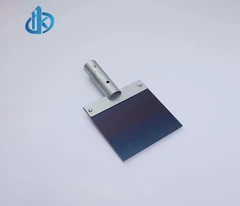

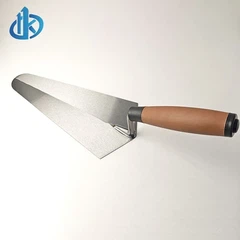

If you've ever stared at a wonky wall corner, plaster smudged where it shouldn't be and edges that look like they've been chewed by a very unhelpful squirrel, you've probably wondered if there's a better way. Enter the corner trowel-a tool that looks like it was bent by a creative blacksmith, with two flat blades meeting at a sharp angle. But does this quirky contraption actually work, or is it just another overhyped gadget gathering dust in the back of your toolbox? Let's cut through the noise and find out.
First, let's talk about why corners are such a headache. Whether you're plastering, tiling, or applying concrete, corners are the awkward middle children of home improvement-neither fully wall nor fully edge, demanding attention but resisting easy fixes. A regular flat trowel, great as it is for straight surfaces, turns into a clumsy giant in tight corners. Try to smooth plaster where two walls meet, and you'll either leave a gap or glob on too much, creating a lumpy ridge that screams "amateur hour." It's like trying to paint a perfect circle with a square brush-possible, but frustratingly difficult.
This is where corner trowels shine. Their angled design fits snugly into 90-degree corners, like a key sliding into a lock. The two blades, usually meeting at a crisp right angle, let you work both sides of the corner at once, spreading material evenly without leaving gaps. I've watched a seasoned plasterer use one, and it was like watching a magician-one smooth motion, and the corner went from ragged to razor-sharp, no extra fuss. It's not magic, though; it's just good design. The trowel's shape does the work for you, guiding the material into place so your hand doesn't have to contort like a pretzel.
But let's get specific. For plastering, corner trowels are a game-changer. When applying the first coat of plaster, called the "scratch coat," corners often get shortchanged because they're hard to reach. A corner trowel lets you push plaster deep into the joint, ensuring it bonds properly to both walls. Then, when applying the finish coat, the trowel's smooth blades create a seamless edge that blends into the rest of the wall. Without one, you'd be stuck using a small putty knife, making tiny, uneven strokes that add hours to the job. It's the difference between building a house with a hammer versus a nail gun-both work, but one is infinitely more efficient.
Tilers, too, swear by corner trowels, especially for setting mosaic tiles or trimming edges. When tiling a shower corner, for example, getting mortar evenly between tiles can be tricky with a regular trowel. A corner trowel's narrow blades slip into the tight space, spreading mortar without dislodging tiles. It also helps with grouting, pushing the material into corner gaps where a float might miss. Think of it as a dental floss for tiling-small, targeted, and essential for getting into places bigger tools can't.
Concrete workers find them useful too, especially when finishing concrete countertops or basement walls. Corners in concrete tend to crack if the material isn't compacted properly, but a corner trowel lets you press concrete into the angle, eliminating air bubbles that weaken the structure. It's like tucking in a bedsheet-getting the corners tight prevents wrinkles (or in this case, cracks) later on.
Of course, no tool is perfect, and corner trowels have their limits. They're designed for 90-degree corners, so if you're dealing with odd angles-like the sloped corners of a gable wall-you'll need a specialty tool or a steady hand with a regular trowel. They also take a little practice to master. The first time I used one, I pressed too hard and squished plaster all over my hand, like squeezing a tube of toothpaste too aggressively. But after 10 minutes of experimenting, I got the hang of it, and now I'd never go back to a flat trowel for corners.
Another myth to bust: corner trowels aren't just for pros. DIYers can benefit even more, honestly. If you're new to plastering or tiling, corners are where mistakes show up the most. A corner trowel acts like training wheels, guiding your movements and reducing the margin for error. I've seen beginners turn out professional-looking corners on their first try, simply because the tool did the hard part. It's empowering, turning a daunting task into something manageable.
So, do corner trowels work? In a word: absolutely. They won't replace your regular trowel-you still need that for straight surfaces-but they're the unsung heroes of corners, turning frustration into satisfaction. Whether you're a weekend warrior or a seasoned pro, a corner trowel is one of those tools that makes you wonder how you ever lived without it. Next time you tackle a corner, give one a try. Your hands (and your walls) will thank you.


