
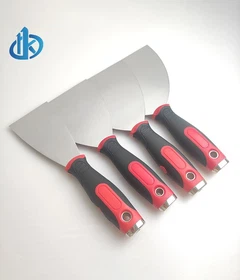
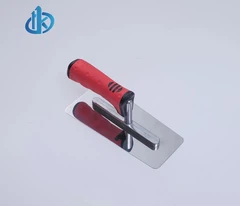
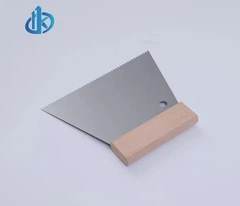
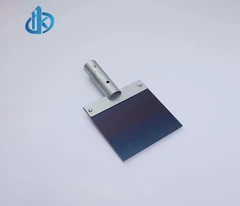

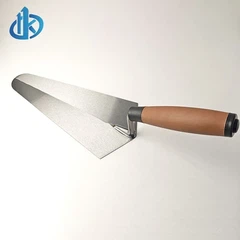

In many fields such as building decoration, putty knives are commonly used tools, and the quality of blade sharpening directly affects their performance.
Recently, our reporter walked into a factory specialized in producing putty knives to explore the technological processes behind blade sharpening.
Inside the factory's production workshop, the first thing that catches the eye is the blade blanks that have already taken shape through precise stamping and other processes.
The first step in sharpening is rough grinding. Workers will fix the blades on professional fixtures and then place them into automated rough grinding equipment.
The grinding wheels of these devices have a specific coarseness. Under high-speed rotation, they can quickly grind off the excess parts of the blade blanks according to the set angles, initially creating the general shape of the blade edge.
This process requires strict control of the grinding force and time to ensure that the blade edge is evenly stressed.
Next comes the fine grinding process. At this time, finer grinding wheels will be replaced, and the operating speed of the equipment will be adjusted accordingly.
The blade edge is slowly and meticulously ground to further improve its sharpness and flatness so that the blade edge reaches the ideal state.
Moreover, during the fine grinding process, experienced quality inspectors will conduct random inspections from time to time, using professional tools to check whether the angle and sharpness of the blade edge meet the standards.
Finally, there is a crucial process - the polishing treatment of the blade edge. Using special polishing materials and equipment, the already sharpened blade is gently polished, which not only makes the appearance of the blade edge smoother and more aesthetically pleasing but also enhances its anti-rust and other properties.


After this whole set of rigorous blade sharpening processes, a sharp and reliable putty knife blade is officially completed. Then it can be assembled onto the handle and enter the market to serve various construction scenarios.


