
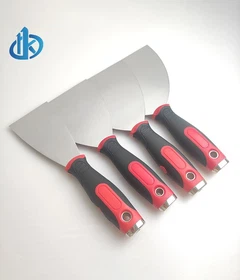


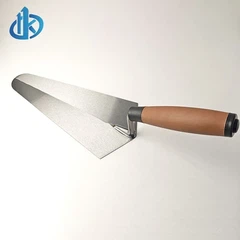

Tempering a putty knife is a crucial process that enhances its mechanical properties, ensuring it can perform effectively and last longer.
The process begins with the selection of the appropriate steel for the putty knife. Commonly, carbon steel is used due to its good balance of hardness and toughness. Once the raw material is obtained, it is heated to a specific temperature, typically in the range of 750 to 850 degrees Celsius. This heating is usually done in a controlled furnace environment to ensure even heating throughout the blade.
After reaching the desired temperature, the putty knife is rapidly cooled, a process known as quenching. This can be achieved by immersing the hot blade into a suitable quenching medium, such as oil or water. Quenching rapidly cools the steel, increasing its hardness. However, this also makes the blade brittle.
To overcome the brittleness and achieve the right combination of hardness and toughness, the putty knife is then tempered. Tempering involves reheating the quenched blade to a relatively lower temperature, usually between 150 to 300 degrees Celsius. This reheating allows the internal structure of the steel to relax and redistribute the stresses caused by quenching.
During tempering, the blade is held at the specific temperature for a certain period, depending on its thickness and the desired final properties. This helps to improve the toughness of the blade while maintaining a sufficient level of hardness. The longer the tempering time, the more the toughness is enhanced, but at the expense of some hardness.
After tempering, the putty knife is cooled slowly, usually in air. This slow cooling further stabilizes the microstructure of the steel. The result is a putty knife with a well-balanced hardness and toughness, capable of effectively spreading and scraping putty without easily deforming or breaking. Overall, the tempering process is a delicate balance of temperature, time, and cooling rates to produce a high-quality putty knife.
Our Products


