
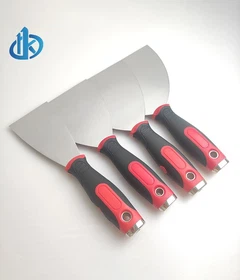



How Many Drywall Knives Do I Need: Precise Planning for Wall Decoration
In the vast realm of architectural decoration, the decision regarding the number of drywall knives often perplexes practitioners. It is by no means a simple matter of numbers; instead, it is closely intertwined with project scale, construction precision, and budget control, constituting a crucial element that determines whether a project can progress smoothly.
Stepping into the decoration battleground of a large commercial complex, which resembles a "super showground" for architectural decoration. From the lofty lobbies of office buildings to the interiors of shopping centers filled with a plethora of brands, the wall area is expansive.
Confronted with the enormous task of wall construction, in order to ensure efficient and high-quality completion, construction teams typically need to be equipped with an adequate number of drywall knives. Different areas have distinct technological requirements. For instance, the lobby walls strive for ultimate smoothness to showcase a high-end texture, necessitating finely polished knives; whereas the interiors of shops may demand knives capable of flexibly handling irregular corners due to personalized renovations.
Roughly estimated, for such a large-scale project, the number of drywall knives usually amounts to dozens, and they are meticulously allocated according to different functional areas and the division of labor among construction teams, much like deploying troops, guaranteeing that every wall detail can be flawlessly presented and enabling the commercial complex to make a stunning debut.

Entering the delicate and warm domain of home decoration, the demand for the number of drywall knives takes on a more "personalized customization" hue. For the decoration of ordinary two-bedroom or three-bedroom apartments, if it is only for routine wall treatment, perhaps a multifunctional, high-quality drywall knife can handle most of the basic work, such as applying wall putty and initial leveling.
However, if the homeowner pursues special wall effects like European carvings or Chinese textures, in order to balance efficiency and precision, construction craftsmen usually prepare an additional two or three knives of different sizes and shapes to carve complex patterns and handle fine corners, injecting unique charm into the home with their skillful hands and creative minds, fulfilling the homeowner's vision of an ideal home.
Looking at the historical stage of ancient building restoration, the arrangement of the number of drywall knives embodies profound respect for traditional techniques. The wall structures of ancient buildings are complex, and the restoration techniques vary for different eras and parts.
Taking a Ming and Qing ancient residence as an example, when restoring the exterior wall, due to the vicissitudes endured by the masonry structure, multiple thick and tough knives are needed to fill gaps and level the wall; while when restoring the indoor wooden partition walls, several small, delicate, and easy-to-operate knives need to be equipped to carefully handle the damage on the wooden surface.
Although the number is not large, each knife bears historical memories and exerts precise force in the hands of restorers, allowing the ancient building to regain its former splendor.
From the rise of bustling commercial complexes, to the creation of warm homes for ordinary people, and then to the rebirth of historical relics, the precise determination of the number of drywall knives is underpinned by a profound understanding of techniques and an accurate insight into requirements, continuously writing a solid prologue for the diverse chapters of architectural decoration.


