
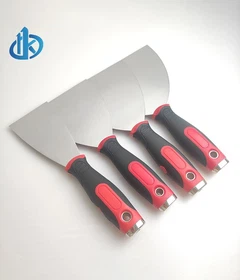
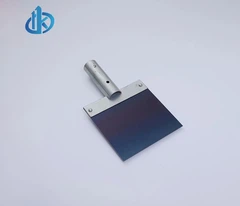

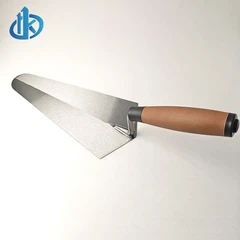

The treatment of the cutting edge of the scraper mainly includes coarse grinding, heat treatment and fine grinding.
Coarsely ground
Before quenching, the upper and lower planes should be smoothed on the coarse grinding wheel, and then the cutting edge of the scraper should be sharpened, and the arc shape of the cutting edge should be sharpened into different arcs according to different scrapers.
Heat Treatment
When the high-carbon tool steel is processed, the cutter head is immersed in a salt bath furnace with a length of 25 mm, heated to 760°~780°C, and then taken out and cooled in water. The quenching length should not be too long, as it will affect the elasticity of the scraper. Due to the high hardness required for the scraper, it should be immersed in water for cooling at one time during quenching, without tempering. If a salt bath stove is not available, it can also be heated in a stove. When heating, pay attention to observation, heating should be uniform, the temperature reaches 760~780 °C, the head of the scraper is dark pink, at this time it should be quickly quenched. If the temperature is too high, even if it is cooled to a suitable temperature and then quenched, it will make the lattice of the scraper structure expand, resulting in the scraper grinding failure.

Fine grinding
After the scraper is quenched, the large plane and blade can be sharpened on the fine grinding wheel first, and it should be cooled in water frequently when grinding to prevent annealing. If the grinding is good during coarse grinding, it can be sharpened directly on the oil stone after quenching. The oil stone for grinding the scraper should be made of white corundum (GB) oil stone with high hardness, and the particle size is better in M7~M5 (800~1000). When sharpening the scraper, it is necessary to work hard to sharpen the two large planes of the scraper, and the edges and corners of the oil stone should be used as much as possible when grinding. Because it is more convenient to use the center of the oil stone, the result is that the oil stone is quickly ground into a saddle shape. When sharpening the large surface of the scraper, it is necessary to pay attention not to grind the large surface into a facet composed of several planes, but to smooth the large surface, and to observe whether this plane has been through to the edge of the cutting edge. The finish of the plane should be polished to more than 12 grades.
In the case of rough scraping scrapers, it can be used by gently grinding the end edge on a fine grinding wheel. After using blunt, the same is processed. If it is a fine knife, the end should also be sharpened on the oil stone, and the angle of the scraper tilting forward should be determined according to the difference of the rough and fine scraper.


