



"Plastic vs Metal Putty Knives: Which One Prevails?"
In decoration and various construction scenarios, putty knives are essential tools, and the debate over which is better between plastic putty knives and metal putty knives has never ceased.
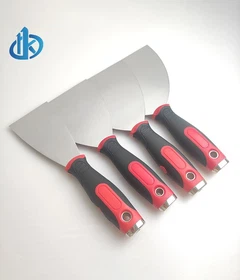
In terms of durability, metal putty knives undoubtedly have the upper hand. Metal materials, especially high-quality carbon steel or stainless steel, possess extremely high hardness and strength and are not prone to deformation or damage during use.
In long-term, high-intensity construction environments, such as the wall treatment of large building projects, metal putty knives can always maintain good performance. The blade is not easily worn and can maintain precise operation for a long time.
Although plastic putty knives can also meet certain requirements in light use scenarios like normal home decoration, if they encounter relatively hard objects or are overused, problems like blade deformation and breakage are likely to occur, and their durability is relatively poor.
Regarding the construction effect, the advantages of metal putty knives are equally obvious. Their blades are sharp and firm, enabling them to spread the putty evenly and smoothly on the wall surface.
For some high-precision decoration work, such as the application of artistic coatings and the handling of fine decorative lines, metal putty knives can better control the force and angle to achieve more perfect results.
When plastic putty knives are used to spread putty, due to the softness of the material, uneven thickness of the putty may result when the force is not applied evenly, affecting the flatness of the wall surface.

However, plastic putty knives are not without their advantages. In some places with high safety requirements, such as kindergartens and nursing homes, the safety of plastic putty knives makes them the top choice.
Their material will not produce sharp edges and corners like metal, and even if they are accidentally dropped or picked up by mistake, they can minimize harm to people.
In addition, plastic putty knives are lighter in weight, which can relieve hand fatigue for workers who hold them for a long time. This advantage is particularly prominent when performing some aerial work or tasks that require raising hands for a long time.
From the cost perspective, plastic putty knives are usually relatively inexpensive and are a cost-effective option for small decoration projects with limited budgets or temporary construction tasks. Metal putty knives, due to the higher cost of their materials and manufacturing processes, are relatively expensive.
But considering long-term use and replacement frequency, if it is a large, long-term construction project, the cost performance of metal putty knives may be higher.
To sum up, plastic putty knives and metal putty knives each have their own advantages and disadvantages. When making a choice, comprehensive considerations need to be made based on specific use scenarios, construction requirements, budgets, and other factors to select the most suitable putty knife to achieve the best construction effect and economic benefits.


