
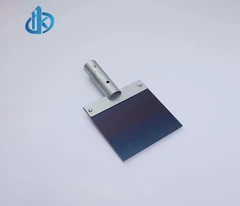

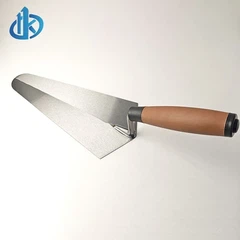

In the field of architectural decoration, the Stainless Steel V Groove Trowel, which has been attracting increasing attention, is playing an important role with its unique design and high-quality materials.
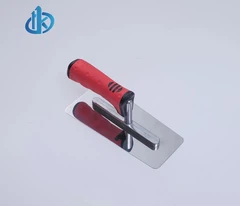
This tool combines a blade made of stainless steel (Stainless blade) with a handle made of rubber-plastic (rubber-plastic handle).
The stainless steel blade ensures that the tool is sturdy and durable and is not prone to rust or corrosion, enabling it to withstand the tests of various construction environments for a long time.
Meanwhile, the rubber-plastic handle offers an excellent grip, effectively reducing hand fatigue when construction workers use it for extended periods and improving the comfort and precision of operation.
In terms of appearance, it features a mirror-polished blade (Mirror polished blade) and a conspicuous red handle (red handle), which is both aesthetically pleasing and easy to identify and locate quickly on the construction site.
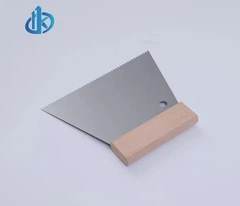
It is worth mentioning that its teeth are of the V-type (V-type teeth).
This design endows it with unique functional uses. In architectural decoration, it is mainly used for applying various bonding materials, such as tile adhesives.
The V-type teeth can accurately control the thickness and uniformity of the applied materials. When laying ceramic tiles, construction workers can use it to evenly spread the tile adhesive on the wall or floor base, ensuring that the tiles can be firmly and smoothly attached, avoiding quality problems such as hollowing.
Moreover, in some decorative processes that require precise leveling, the Stainless Steel V Groove Trowel can also demonstrate its capabilities.
It can use the V-type teeth to comb leveling materials like putty to create a flat surface that meets the requirements, laying a good foundation for subsequent decorative procedures.


As the requirements for construction quality and efficiency in the architectural decoration industry continue to rise, this Stainless Steel V Groove Trowel, which is both practical and aesthetically appealing, is expected to be widely used in more engineering projects, helping to create higher-quality decorative results.


