



What is the best material for a putty knife
Recently, with the continuous growth of the construction, decoration, and DIY markets, a seemingly fundamental yet crucial question has sparked widespread discussion: What exactly is the best material for putty knives? This topic not only concerns the work efficiency and quality of professional construction workers but also impacts the user experience of numerous DIY enthusiasts.
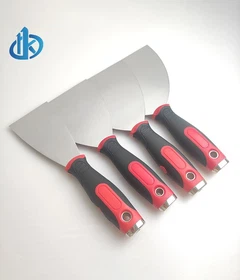
Traditionally, carbon steel has been a commonly used material for making putty knives. Putty knives made of carbon steel possess high strength and hardness, enabling them to effortlessly handle onerous tasks such as scraping off old paint and removing stubborn dirt.
Their sharp blades can precisely deal with various gaps and corners, performing remarkably well when working on surfaces like walls and wood. However, carbon steel also has obvious drawbacks.
Its susceptibility to rust is the most significant issue. Especially after being used in a humid environment, if not properly maintained, carbon steel putty knives will quickly develop rust marks, which not only affect their appearance but also reduce their service life.
To address the rust - prevention problem of carbon steel, stainless steel has gradually become a popular choice for putty knife materials. Putty knives made of stainless steel have excellent corrosion - resistance. Whether used in a humid indoor environment or for outdoor operations, they can always keep the blade intact.
This significantly reduces the maintenance cost of stainless - steel putty knives, as users don't need to spend too much effort on maintenance. In addition, the smooth surface of stainless steel allows the putty or putty material to adhere more evenly when applying, thus enhancing the construction effect. However, the relatively high cost of stainless steel results in generally high product prices, which, to some extent, limits its market penetration.

Meanwhile, plastic - made putty knives also have a place in the market. Plastic putty knives are lightweight and more labor - saving to use. For those who work with their hands for long periods, they can effectively reduce fatigue. Moreover, plastic does not rust and has a certain degree of flexibility.
When dealing with some relatively soft or vulnerable surfaces, it is less likely to cause scratches. However, its hardness and wear - resistance are relatively weak, making it unsuitable for removing hard attachments, and its application range is relatively narrow.
In market research, many professional decoration workers stated that for daily fine - decoration work, stainless - steel putty knives are the first choice, as their durability and construction effects are both satisfactory. In some temporary or simple repair work, the convenience of plastic putty knives has more advantages.
For DIY enthusiasts, considering the cost and frequency of use, carbon - steel putty knives, when paired with appropriate rust - prevention measures, still offer good cost - effectiveness.
With the continuous advancement of material technology, there may be higher - quality and more cost - effective materials applied to the production of putty knives in the future. But for now, constructors and consumers need to carefully select suitable putty - knife materials according to their specific needs to ensure the smooth progress of construction and achieve the desired results.


