
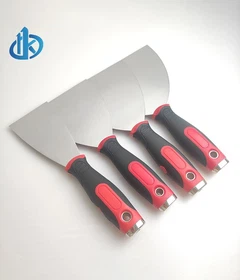
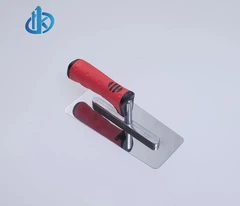



Trowels for Plastering and Finishing: Differences in Function and Application
In the fields of construction and decoration, trowels for plastering and finishing are two commonly used tools, and they have some differences in terms of function, shape, and applicable scenarios.
Functional Features
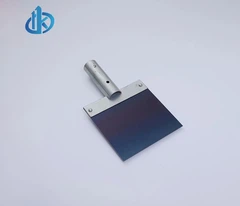
Plastering Trowel: It is mainly used for applying, spreading, and initially leveling mortar or other similar materials. It needs to have sufficient strength and rigidity to scoop a large amount of materials from the mortar bucket and apply them to the wall or floor surface. Meanwhile, it can also conduct preliminary compaction and rough leveling of the materials.
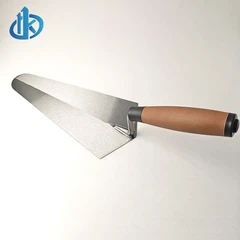
Finishing Trowel: Its main function is to conduct fine processing on the surface of the already applied mortar or concrete to obtain a smooth and flat surface finish.
The finishing trowel usually has a thinner and more flexible blade, which can better adhere to the surface for subtle adjustments and refinements.

Shape and Size
Plastering Trowel: Generally speaking, the blade of the plastering trowel is wider and thicker, mostly rectangular in shape. The width is usually about 4 - 6 inches, and the length is between 12 - 16 inches. Such a size design is conducive to applying a large area of materials at one time and improving work efficiency.
Finishing Trowel: The blade of the finishing trowel is relatively narrower, thinner, and more flexible, with a width of perhaps 3 - 5 inches. The length is similar to that of the plastering trowel, but there are also some shorter styles, which are convenient for operation in narrow spaces or at detailed parts. Its corners are usually sharper, enabling more precise handling of edges and corners.
Applicable Scenarios
Plastering Trowel: It is commonly used in basic work such as wall plastering and ground leveling in construction. In these scenarios, it is necessary to quickly apply a large amount of mortar to the base layer and conduct a rough leveling, laying the foundation for the subsequent finishing work. For example, in the wall construction of a new house, the plastering trowel can evenly apply cement mortar on the brick wall, fill the gaps, and form a basically flat surface.
Finishing Trowel: It is more applied in occasions with high requirements for surface smoothness and flatness, such as the last plastering process of interior walls and the polishing of concrete floors. For example, in the decoration of high-end residences, the finishing trowel is used to make the putty or mortar on the wall as smooth as a mirror, enhancing the overall decoration texture. In the ground construction of commercial buildings, the finishing trowel can finely polish the concrete surface to make it achieve an aesthetic and durable effect.


