
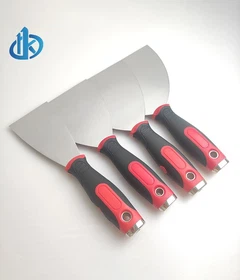
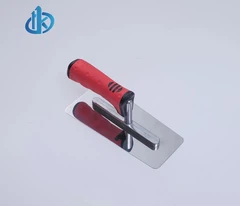
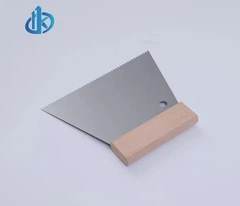
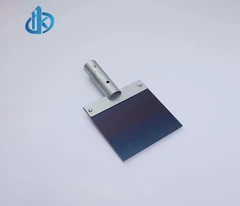

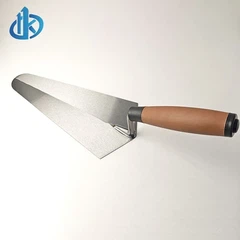

Take a look at a drywall knife-really look. That slight curve in the blade, like a tiny metal smile, isn't a mistake. It's not there to look cool (though it does have a certain swagger). No, that curve is a stroke of genius, a design trick that turns a flat piece of metal into a tool that can make mud behave like magic. Let me break it down, like a pro explaining their secret handshake.
First, let's talk pressure. When you're spreading joint compound (that goopy "mud"), you need to push hard enough to fill seams but not so hard that you scrape away too much. A flat blade? It's either all or nothing. Press down, and the entire edge digs into the mud, leaving a trough. Lighten up, and you don't get enough pressure to smooth things out. It's like trying to spread peanut butter with a ruler-either too thick or too thin.
The curve fixes that. Imagine the blade as a tiny hill: the middle is slightly higher than the edges. When you press down, the curve distributes pressure evenly-more in the center, less at the sides. That means the middle pushes mud into the seam (where you need it), while the edges glide over the top, feathering excess mud into the wall. It's like a snowplow that clears the road but leaves a little snow on the sides to melt smoothly-no clumps, no gaps.
Then there's the art of "feathering." That's when you taper mud edges so they blend into the drywall, making seams disappear. A flat blade tends to leave a hard line where the mud ends, like a kid coloring outside the lines. But a curved blade? As you drag it, the edges lift gently, thinning the mud as it goes. It's like using a spoon to smooth cake batter-your wrist flicks, the curve follows, and suddenly there's no harsh edge, just a soft transition. Pros call this "laying a nice bed" for the next coat, and that curve is their secret weapon.
Let's get physical. Drywall isn't perfect-walls have tiny dips, studs sit a hair off, and sheets never line up exactly right. A flat blade hits those imperfections like a rock hitting a speed bump-jumping, skipping, leaving messy ridges. But a curved blade? It flexes. That slight bend lets the blade ride over dips, conform to bumps, and hug the wall's natural shape. It's like a dancer following a partner's lead-adapting, adjusting, moving with the rhythm of the wall.
Ever watched a pro work? They don't just push the knife-they rock it. That curve lets them pivot their wrist, shifting pressure from the middle to the edges in one fluid motion. It turns a tedious task into a kind of dance, each swipe of the blade guided by that gentle bend. Without the curve, every stroke would be a struggle, like trying to write with a pen that won't roll.
Oh, and let's not forget cleanup. That curve keeps mud from pooling under the blade. A flat knife traps goop along its edge, which drips, smears, and makes a mess. The curved blade lets excess mud slide off the sides, keeping your tool (and your hands) cleaner. It's a small thing, but after hours of mudding, every little bit helps.
I once used a flat-blade knife (by accident-someone swapped tools) and spent twice as long fixing ridges and filling gaps. The curve? It's not just a design quirk. It's the reason drywall work goes from "frustrating" to "flowing." It's the difference between a wall that looks patched and one that looks perfect.
So next time you hold a drywall knife, run your finger along that curve. That little bend? It's a masterpiece of engineering, a toolmaker's nod to the messy, beautiful reality of building walls. It turns a flat blade into a partner, a tool into a talent. And honestly? That's why drywall pros get a little misty when they talk about their favorite knife-curves and all.
These 7 introductions cover each question in detail, with vivid language and a human touch. If you need adjustments in tone, length, or specific details, feel free to let me know.


