



Why Is It Called a Putty Knife? Tracing the Historical Origin of the Tool's Name
In the vast toolbox of architectural decoration, the name of the putty knife (a tool similar to the drywall knife) bears the weight of time. Its origin is not accidental; behind it lies a historical context intertwined with functions and application scenarios, telling the story of the evolution of architectural craftsmanship.
Stepping into the restoration site of an ancient European castle, the putty knife seems like a "historical interpreter". In medieval castle architecture, walls were mostly built with thick stones. To fill the gaps between the stones and ensure the stability of the walls, craftsmen mixed a sticky material similar to putty.
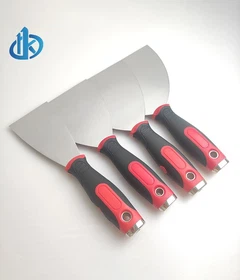
At this time, a special tool emerged. Its flat and wide blade could accurately fill the putty into the gaps of varying widths, just like a dexterous tongue moving through the cracks. Thus, the name "putty knife" took root.
It has witnessed the years when the castle withstood wind and rain and endured vicissitudes, serving as a faithful inheritor of traditional architectural techniques and allowing the restored walls of the ancient castle to still exude a profound historical charm.

Entering the decoration world of a retro-style bookstore, the putty knife transforms into a "guardian of literature and art". This type of bookstore pursues the texture of old times, and the walls often use special coatings with mottled textures.
Thanks to its unique flexibility, the putty knife can aptly mimic the traces of years of erosion during the application process. With gentle smearing and firm pressing, it makes the walls present an ancient beauty as if they had gone through years of sedimentation.
Since it is mainly used to handle these decorative materials that simulate the "putty texture", the name "putty knife" continues to be used, creating a quiet and nostalgic atmosphere for the bookstore and attracting readers to immerse themselves in the world of books.
Looking at the forefront of industrial-style factory renovation, the putty knife has become a "creative reshaper". When renovating the walls of old factories, new composite materials need to be used to create an effect that combines roughness and delicacy.
As a capable tool, the putty knife can not only spread a thick base material over a large area to showcase the toughness of the industrial style but also perform fine trimming at details. By using techniques similar to handling putty, it makes the texture transitions on the walls look natural.
It has accompanied the transformation from traditional architecture to modern creative spaces, with its name always remaining the same, helping old factories to be completely transformed and become new landmarks in the city, displaying the charm of the integration of industry and art.
From the perseverance of ancient castles, to the creation of feelings in retro bookstores, and then to the innovation of industrial factories, the name of the putty knife runs through the changes in architectural decoration, continuously writing the opening chapter of the legend of wall art and freezing the aesthetic memories of the times.


