
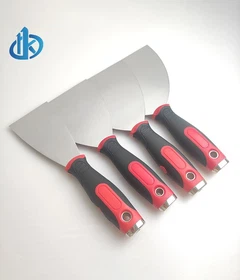
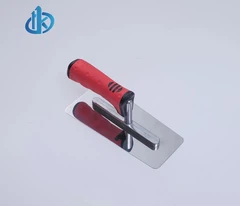


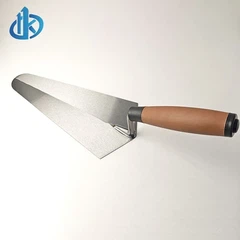

A finishing trowel is a commonly used tool in the construction and plastering industry, but the question of whether it can be used for plastering requires a more in-depth exploration.
A finishing trowel is typically designed with a flat, smooth blade. It is engineered to provide a final, polished surface to plaster or other similar materials. The blade is usually made of stainless steel or carbon steel, which offers durability and the ability to create a sleek finish.
When it comes to plastering, a finishing trowel can indeed be used, but its application is more suited for the later stages of the process. In the initial stages of plastering, when the plaster is being applied to the wall or surface, a larger hawk and a trowel with a more scooping or spreading shape are often preferred. These tools help to evenly distribute the plaster in a relatively rough and thick layer.
However, as the plaster starts to set and the surface needs to be smoothed and leveled to achieve a fine finish, the finishing trowel comes into play. Its flat and smooth blade allows the plasterer to gently glide over the surface, removing any small imperfections, ridges, or bumps. It helps to create a seamless and uniform texture, giving the plaster a professional and aesthetically pleasing look.
One of the key advantages of using a finishing trowel is the precision it offers. The plasterer can carefully manipulate the blade to feather out edges and blend different areas of the plastered surface. This is especially important in areas where the plaster meets other surfaces or in corners where a clean and sharp finish is desired.
It's important to note that using a finishing trowel effectively requires some skill and practice. The angle at which the trowel is held, the pressure applied, and the direction of the strokes all contribute to the final outcome. Novice plasterers may need to experiment and learn the proper techniques to achieve the best results.
In conclusion, while a finishing trowel is not the sole tool for plastering, it is an invaluable asset in the later stages of the plastering process. It helps to transform a roughly applied plaster surface into a smooth, finished work of art, enhancing the overall quality and appearance of the plastered area.


