



Unveiling the Scraper: A Small Tool with Great Power
In numerous fields such as construction, home decoration, and industrial production, the scraper is a common and indispensable tool. Despite its seemingly simple appearance, it embodies ingenious design and an efficient working principle, playing a crucial role in various tasks. So, how exactly does a scraper work?
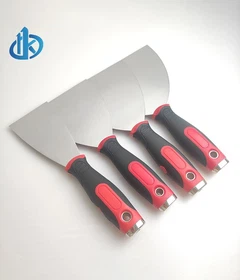
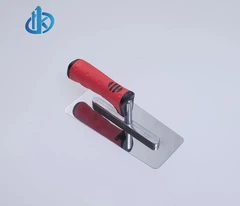
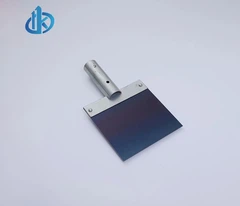
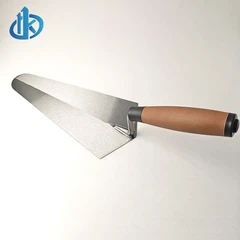
A scraper is mainly composed of two parts: the blade and the handle. The blade is its core working component, usually made of high - strength and wear - resistant materials, such as high - quality steel.
These materials, through special processing techniques, endow the blade with a sharp cutting edge and good toughness, enabling it to maintain stable performance in different working environments.
The handle is designed for the convenience of users to hold and operate. Its design focuses on ergonomics to ensure that users can remain comfortable during long - term use and reduce hand fatigue.

The working principle of a scraper is based on simple and effective mechanical principles. When a user applies pressure to the handle, the force is transmitted from the handle to the blade. The blade, with its sharp edge, cuts into or scrapes the surface of the material that needs to be processed.
In the construction and home - decoration fields, scrapers are often used to clean old coatings, dirt, plaster, etc. on walls or floors. For example, in wall renovation projects, workers use scrapers to remove the old paint layers or fallen plaster, creating a flat base for new decoration work. The blade of the scraper can precisely control the scraping force and range, ensuring that the base layer is not overly damaged.
In industrial production, the application of scrapers is even more extensive. In the printing industry, scrapers are used to remove excess ink from printing plates, ensuring the clarity and accuracy of printed patterns.
In this case, the working precision of the scraper is extremely high, and it needs to accurately control the thickness and uniformity of the ink scraping to meet the requirements of different printing processes. In the plastic - processing industry, scrapers can be used to clean the residual plastic on the mold surface, preventing the plastic from accumulating in the mold and affecting product quality.

The working efficiency and effectiveness of a scraper are also influenced by various factors. The sharpness of the blade is one of the key factors. A sharp blade can more easily cut into the material, reducing the required force and time.
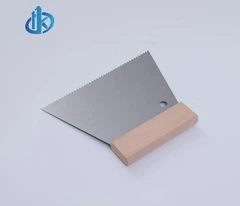
At the same time, the shape and angle of the blade are also optimized according to different work tasks. For example, the blade of a scraper used to scrape flat dirt is usually relatively flat, while the blade of a scraper used to clean gaps or corners may be designed at a special angle or in a special shape to facilitate operation in narrow spaces.
In addition, the operation skills and experience of the user also play an important role in the working effect of the scraper. Skilled users can reasonably adjust the pressure and angle applied to the scraper according to the nature of the material and the work requirements, thus achieving the best working effect.
Overall, although the scraper may seem ordinary, through its ingenious design and reasonable working principle, it plays an important role in various fields. With the continuous progress of science and technology, the design and manufacturing processes of scrapers are also constantly improving.
In the future, we can expect to see more efficient and intelligent scraper products, providing stronger support for the development of various industries. Whether it is large - scale industrial production or small - scale home - improvement repairs, the scraper will continue to play an indispensable role, bringing more convenience to people's work and life.


