
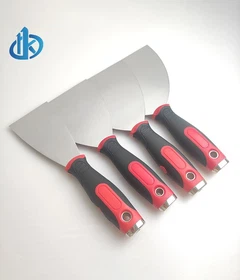
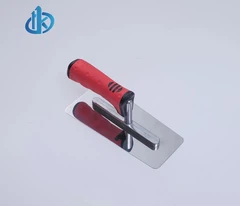



How to Properly Use a Trowel?
In the vast fields of construction and industry, the trowel, as a fundamental yet crucial tool, has a direct bearing on the quality and efficiency of projects. Mastering the tricks of using a trowel can enable users to achieve twice the result with half the effort and create higher-quality works.
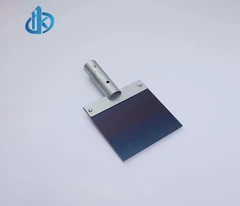
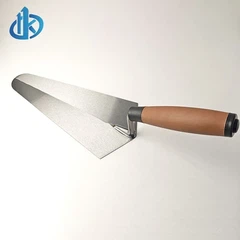
In the field of architectural decoration, taking wall plastering as an example, it is necessary to select a suitable trowel before use. For large-area rough leveling, a trowel with a wider blade and a slightly curved surface can be chosen to quickly and evenly spread the mortar.
When holding the trowel, the hand should be steady and the force moderate, with the thumb, index finger, and middle finger working closely together to control the direction of the trowel.
When plastering, start from fixed points such as the corner of the wall and proceed from bottom to top and from left to right in sequence, allowing the mortar to adhere closely to the wall to avoid hollowing or uneven thickness. The amount of mortar dipped each time should be appropriate. Too much is likely to fall off and cause waste, while too little will affect the continuity of the application.

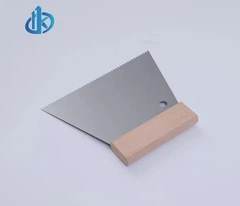
Entering the tile paving stage, there are differences in the use of trowels for different types of tiles. The square-notch and U-notch trowels mentioned earlier each have their own strengths and need to be matched correspondingly.
For laying large-size tiles, use a square-notch trowel and drag it in a straight line at a uniform speed when applying the glue to ensure regular adhesive strips. For small irregularly shaped tiles, pair them with a U-notch trowel and gently apply the glue in a circular motion to evenly cover the complex surface.
In the industrial manufacturing category, such as in the production of ceramic products, the trowel is used to trim the green body. When operating, the movements should be precise, slowly scraping along the curvature of the green body to remove the excess clay and shape an accurate appearance.
Improper control of the force may damage the green body. Also, when applying industrial sealing materials, the trowel should be at a 45-degree angle to the gap, fitting closely and compacting the material to fill the gap and ensure the sealing effect.
All in all, whether it is building a warm home or boosting industrial development, the application of the trowel is a crucial link. Only when users master the skills proficiently can this small tool exert its maximum effectiveness and lay a solid foundation for various projects.


