



When to Use a Trowel vs a Taping Knife?
In the complex fields of construction and home improvement, choosing the right tool isn't merely about convenience-it's the cornerstone of achieving professional - grade results. Two commonly employed tools, the trowel and the taping knife, often baffle DIY enthusiasts and even some novice professionals regarding their specific applications. Understanding when to use each can significantly impact the efficiency and final outcomes of various projects.
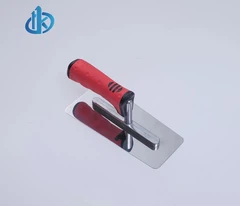
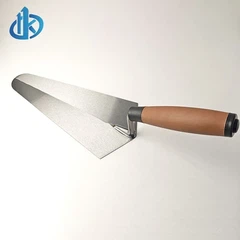
When large - scale material spreading and surface shaping tasks are at hand, the trowel takes the spotlight. In masonry work, such as bricklaying or stone paving, a trowel is indispensable for applying mortar. Its broad, flat blade enables masons to scoop up substantial amounts of mortar and spread it evenly across the surfaces of bricks or stones.
This ensures a strong bond between each unit, contributing to the overall structural stability. For instance, when constructing a brick wall, the trowel aids in creating consistent mortar joints, which are not only aesthetically pleasing but also vital for the wall's durability.
In the realm of concrete construction, trowels are equally essential. Finish trowels are utilized to smooth and finish the surface of freshly poured concrete. By skimming over the concrete, these trowels eliminate imperfections, create a uniform texture, and enhance the surface's strength and wear resistance.
They are also used to give the concrete a final polish, imparting a professional appearance. Another type, the float trowel, is employed during the initial stages of concrete finishing to compact the surface and remove excess water, preventing issues like cracking and pitting.

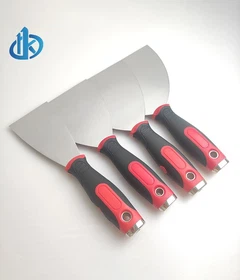
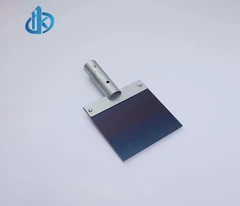
On the flip side, taping knives excel in tasks related to drywall installation and finishing. Once drywall panels are installed, the gaps and joints between them need to be sealed, and this is where taping knives come into play. A taping knife is used to apply joint compound over these joints and then embed paper or mesh tape into the compound.
The thin, flexible blade of the taping knife allows for precise application of the compound, ensuring that the tape adheres properly and the joints are smooth. This process is repeated several times, with each layer of joint compound smoothed out using the taping knife to create a seamless finish.
In addition to joint taping, taping knives are also used for skim coating. Skim coating involves applying a thin layer of joint compound over an entire drywall surface to smooth out imperfections, repair damaged areas, or create a better base for painting. The taping knife's ability to spread the compound evenly and smoothly is crucial for achieving a high - quality skim coat.
Furthermore, in tasks that require fine detailing, such as filling small holes or cracks in drywall, a taping knife can be more precise than a trowel. Its narrow blade can reach into tight spaces and apply just the right amount of compound, minimizing the need for excessive sanding and touch - ups later.
In conclusion, while both trowels and taping knives are essential tools in construction and home improvement, their application scenarios are distinctly different. Trowels are best suited for tasks involving large - scale material application, surface shaping, and finishing in masonry and concrete work.
Taping knives, meanwhile, shine in drywall - related tasks, from joint taping to skim coating and detailed repairs. By choosing the appropriate tool for each task, one can ensure that every project is completed efficiently and accurately, resulting in high - quality work that stands the test of time.


