
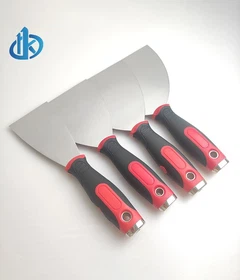
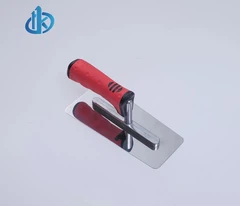
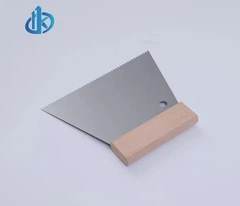
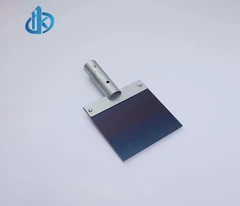

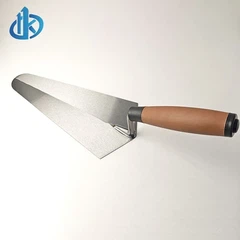

In the building decoration industry, the Plastering Trowel is an extremely common and crucial tool, and the design of its blade with V-shaped teeth has always attracted much attention. There are numerous benefits behind this design.
From the perspective of construction results, the design of V-shaped teeth helps to better grab and spread the materials.
For example, when plastering the wall, the V-shaped teeth can embed into materials like cement mortar, enabling the materials to adhere to the blade more evenly and firmly.
When the materials are then spread onto the construction surface such as the wall, a smooth and tightly bonded effect can be achieved, effectively avoiding problems like uneven spreading of materials and hollowing, and greatly improving the flatness and aesthetics of the wall surface.
In terms of construction efficiency, this tooth shape also plays an important role. Compared with traditional smooth blades, the V-shaped teeth can scoop up materials more quickly.
With one scoop, more materials can be carried more fully, reducing the number of times of repeatedly fetching materials and allowing construction workers to complete the spreading work on a large area more rapidly, thus speeding up the overall project progress.
Meanwhile, the design of V-shaped teeth also enhances the durability of the blade.
During the long-term contact and friction with various relatively rough building materials, the tooth-shaped structure distributes the force, reducing excessive local wear and prolonging the service life of the blade of the Plastering Trowel.
It also reduces the frequency of replacing construction tools and saves costs for the construction party to a certain extent.


It can be said that the design of the V-shaped teeth on the blade of the Plastering Trowel is a clever idea that has been tested in practice and has played a positive role in promoting high-quality and high-efficiency construction in the building decoration industry.


